

Last Updated: November 10, 2026
Quick Summary
Custom plate holders fit imported car chassis only when you measure the recess, not the plate: record recess width and height at the tightest point, hole spacing centre to centre, depth, and curvature. If the centre gap exceeds about 5 mm, choose a flexible frame that follows the bumper curve.
- Measure front and rear bumpers separately, since front recesses are often shallower or more curved.
- Measuring at the widest lip instead of the tightest point is the most common fitting error.
- Dry-fit the holder with the plate before drilling, and test parking sensors first.
- Tighten screws in a cross pattern a quarter turn at a time to avoid cracking plastic.
- TAPORT custom holders start at £19.99 and are designed to mount without drilling.
Table of Contents
- Why Imported Chassis Need Different Custom Plate Holders
- Number Plate Holder Measurements for an Import Chassis
- Imported Car Number Plate Size and UK Legal Requirements
- Number Plate Holder Fitting: Screws, Clips and Adhesive
- Custom Printed Number Plate Surrounds for Import Owners
- Ordering Your Custom Plate Holder From TAPORT
- Frequently Asked Questions
Why Imported Chassis Need Different Custom Plate Holders
A Japanese import rarely arrives with a plate recess built for a standard UK plate. That mismatch is the whole problem, and it is why custom plate holders for imported car chassis need more thought than a universal frame bought off the shelf.
The same question comes up again and again: will it fit? The honest answer starts with measurement, not with the product photo. Most holders sold as "universal" assume a flat 520 mm x 111 mm recess.
Below, we explain how to measure your recess, pick a holder that fits, fit it without drilling into the wrong place, and stay on the right side of plate rules. Get this right and a custom holder looks factory-fitted.
Front and Rear Fitment Differences
Front and rear bumpers are not twins. On many imports the front recess is shallower or sits on a more pronounced curve, while the rear is flatter but narrower. Measure both separately and note which way each surface curves. A holder that sits perfectly on the rear can stand proud at the front, and that gap is where vibration starts.
Number Plate Holder Measurements for an Import Chassis
Custom plate holders only fit when you measure the recess, not the plate. Take three numbers: the internal width of the recess, the internal height, and the distance between the existing mounting holes.
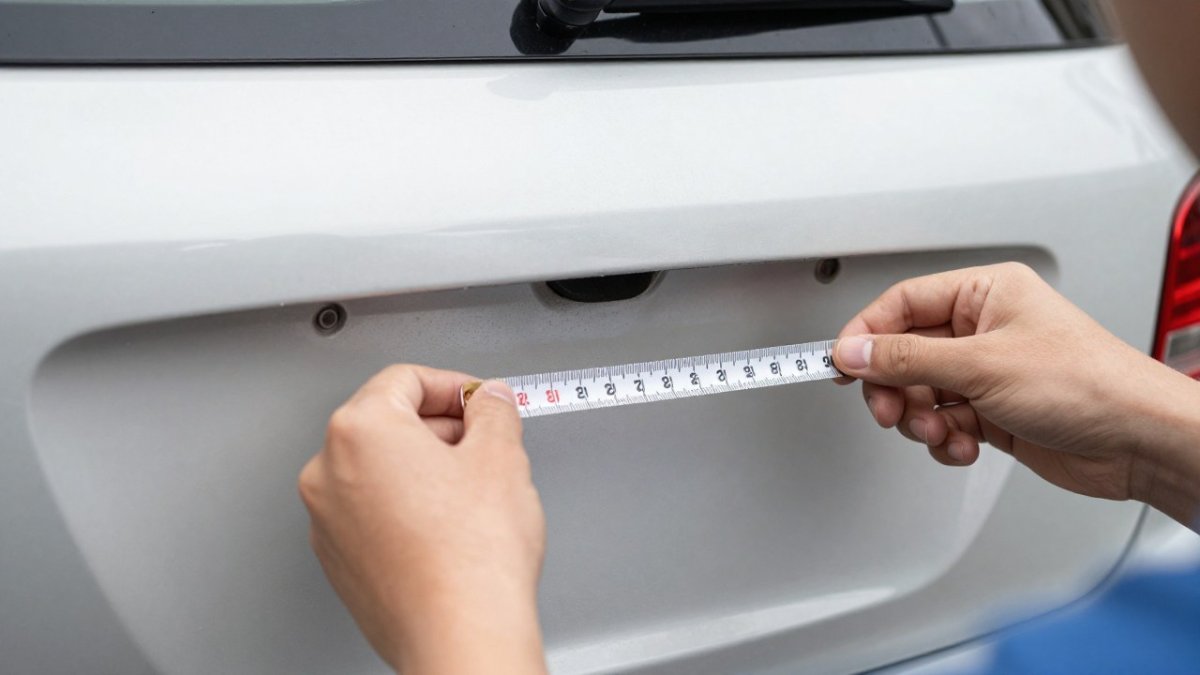
Work in millimetres and write the figures down in this order:
- Recess width and height, measured at the tightest point, not at the widest lip
- Hole spacing, centre to centre, measured twice (top pair and bottom pair if there are four)
- Depth from bumper face to recess back, taken at the centre and at each end
- Curvature: flat, gently curved, or round-edged, hold a straight edge across the opening and note the gap at the centre
- Any step or lip where the bumper skin meets the recess moulding
If your hole spacing is wider than the frame's slots, you either drill the frame or use a holder with slotted or multi-position fixings. Measure the slots on any holder you are considering before you buy, not after.
For curvature, the test is simple: lay a steel rule across the recess opening at plate height.
Watch out: measuring the recess at its widest lip rather than its tightest point is the most common error, and it produces a holder that fouls the bumper skin at the corners.
If the recess is narrower than a standard UK plate, a flexible frame that follows the bumper curve will sit flatter than a rigid one. Check the government guidance on display of registration marks before you assume a smaller plate is allowed.
Imported Car Number Plate Size and UK Legal Requirements
The imported car number plate size question trips up more owners than any other. A plate must show the correct characters in the correct font, and it must be readable. Legibility is where a sagging or faded holder becomes a legal problem, not just a cosmetic one.
Keep the plate flat, secure and clean. A holder that lets the plate curl at the edges can obscure characters. If your plates are already showing wear, our guide on how to prevent car plate fading and keep plates legible covers the practical steps.
Watch out: fitting a plate that is too small for the recess to make a holder fit can leave characters undersized. Check the rules first, then choose the holder.
Number Plate Holder Fitting: Screws, Clips and Adhesive
Fitting comes down to three methods, and each suits a different bumper. Screw fixing is the most secure but needs existing holes or new ones you are confident about. Clip-on holders grip the plate edge and need no drilling. Adhesive fixing suits smooth, flat surfaces and clean preparation.
Before you commit, it is worth weighing up whether weather resistant car accessories are worth it for a car kept outside, because a holder that loosens in the cold will rattle within a season.
A practical installation sequence for an imported chassis looks like this:
- Dry-fit the holder against the recess with the plate loosely in place. Check the plate sits flat, the holder does not foul the bumper skin, and the plate edges are not pinched.
- Mark the existing holes through the holder's slots with a pencil, not a drill bit. If the holder's slots do not reach the existing holes, note the offset before deciding whether to drill.
- If you must drill, use the existing holes as a template where possible, start with a pilot bit smaller than the screw, and stop at the depth of the bumper skin, not the depth of the recess.
- Add a rubber or foam buffer behind the plate to stop vibration, and check alignment against the bumper line before final tightening.
- Tighten in a cross pattern, a quarter turn at a time, until the holder is snug. Plastic cracks when a single screw is driven home first.
A common mistake is overtightening screws into plastic. It cracks the surround and the plate works loose.
For vibration and rattling, the usual causes are a holder that stands proud on a curved bumper, a missing buffer, or screws that have loosened in cold weather. Refit with a buffer and a thread-locking compound rather than simply tightening harder.
Checking Sensors, Cameras and Airflow Before You Drill
Modern bumpers hide parking sensors, reversing cameras and air intakes behind the panel. A holder that sits too proud can block a sensor's field or interrupt airflow to an intercooler. Hold the holder in place, switch the ignition on, and test the sensors before you drill anything. On imports with sensors set close to the plate recess, a holder that adds more than a few millimetres of stand-off can trigger false alerts, check the sensor's field with the holder in place, not after it is fixed.
Custom Printed Number Plate Surrounds for Import Owners
This is where an import stops looking like an import.
Our surrounds use UV digital printing with epoxy resin gel doming, which is weather, temperature and vibration resistant. That matters on a car that lives outside.
For import owners, the practical win is a holder that follows the bumper curve while carrying a clean printed edge. Choose a design that matches or deliberately contrasts with the body colour.
Best for: owners who want a personalised finish on a curved import bumper. Skip if: you need a plain, unbranded frame and nothing else.
Ordering Your Custom Plate Holder From TAPORT
Ordering is straightforward once you have your measurements. Our custom holders suit any car with a standard-size plate, include fixings and a manual, and are designed to mount without drilling. Prices start at £19.99 for a single customised holder.
Send your idea at checkout or by email with your PDF file.
| Holder option | Price | Best for |
|---|---|---|
| Single customised holder | £19.99 | One end of the car, gifts, adverts |
| Pair with custom text, photo or logo | £25.99 | Full front and rear matching set |
| Pair with customised text or design | £29.99 | Business branding across a fleet |
Price
For a curved or imported bumper, pick the flexible frame and measure twice. If you are ready to order, you can shop the customised plate holder for any car or browse the custom text, photo and logo surrounds. Our guide to durable number plate holders for daily commutes explains what to look for if your car sits outside.


An imported chassis punishes guesswork: the recess is rarely standard, the bumper curves differently front to rear, and a holder that fits one end can rattle at the other. Measure the recess and hole spacing, check sensor clearance, then match the fixing method to the surface.
Frequently Asked Questions
How do I check whether a number plate holder will fit an imported car?
Measure the plate recess width and height in millimetres, then note where the existing mounting holes sit. A standard UK plate is 520 x 111 mm, so a holder built for that size will only sit flush if your recess is at least that wide. If the recess is narrower or the holes are off-centre, a flexible surround that follows a curved or round edge is the safer choice. Check the holder's stated plate dimensions against your measurements before ordering.
Are number plate holders different for imported cars?
The holder itself is usually the same standard UK or European size, but the chassis it bolts to is not. Japanese imports often have narrower recesses, offset mounting points or curved bumpers that a rigid frame will not follow. That is why number plate holder measurements matter more than the holder's label. A flexible surround plus the correct fixings handles most import chassis, and custom plate holders let you match the frame to the recess rather than forcing a fit.
What fixings should I use for custom plate holders?
Use the fixings supplied with the holder where the holes line up. TAPORT holders ship with fixings and a manual, and mount in one to three minutes without drilling. If your import has no usable holes, self-tapping screws into the plastic bumper are the usual route, backed with a rubber buffer to stop rattling. Avoid adhesive alone on textured or curved bumpers, because vibration and weather will loosen it over time.
Can I fit a UK-sized number plate to an imported car?
Yes, provided the plate meets the legal character size and spacing rules and fits the recess without being cut down or obscured. Measure the recess first: a 520 x 111 mm plate needs a clear flat area at least that wide. If the recess is smaller, check whether the bumper can take a holder that sits slightly proud of the body. Keep the plate visible from the front and rear and free of any cover that alters its appearance.
