

Last Updated: November 1, 2026
Quick Summary
Durable number plate holders for a daily commute should match the material to your conditions: stainless steel or premium matte black for gritted roads and road salt, and silicone or rubber-coated frames for frequent rain and paint protection. Avoid unbranded high-gloss and chrome-effect finishes, which pit and flake first, and hand-tighten fixings so plastic frames do not crack at the screw holes.
- Standard UK plates measure 520 mm by 111 mm, so measure your plate and recess before ordering.
- Our hinged surrounds mount in one to three minutes with no drilling and include fixings and a manual.
- Tap the fitted frame with a knuckle: a rattle means the plate is loose and will fret.
- Never drill new holes in a bumper; use existing plate fixings or a no-drill holder instead.
- Rinse the frame when you wash the car and check the fixings every few months.
Table of Contents
- What Daily Commuting Does to a Number Plate Holder
- Number Plate Holder Materials: What Survives Rain, Salt and Sun
- Universal Number Plate Holder Fit: Checking Your Car and Plate Size First
- Number Plate Holder Fitting: Screws, No-Drill Options and Legal Visibility
- Custom Printed Number Plate Surround: Personalising a Daily Driver
- Choose Your Holder and Fit It This Weekend
- Frequently Asked Questions
What Daily Commuting Does to a Number Plate Holder
Number plate holders are frames that secure and surround a vehicle's registration plate, and the daily commute is the hardest test they will ever face.
Most buyers shop on looks, fit the number plate holders, and forget them until an MOT tester flags an insecure plate.
Below, we break down materials, fit, fixing methods and the legal points that matter, so you can choose a holder that survives the commute rather than one that looks good for a season.
Number Plate Holder Materials: What Survives Rain, Salt and Sun
ABS plastic is the budget standard: lightweight and cheap, but cheaper grades go brittle with UV exposure and crack around screw holes.
Stainless steel resists rust and holds its shape, making it a strong pick for coastal commutes or anywhere gritting trucks run.
Silicone and rubber-coated frames absorb vibration and will not chip paint where they touch the bodywork.
For a durable number plate holder, avoid unbranded high-gloss finishes.
How we assess daily-commute durability
Most listings make durability claims without saying how they were reached. A practical assessment you can repeat yourself comes down to four checks:
- Vibration: tap the fitted frame firmly with a knuckle. A dull, solid note suggests a tight fit; a rattle means the plate is loose and will fret over thousands of miles.
- Flex: press the centre gently. It should flex slightly and return. A rigid, brittle frame is the one that cracks at the screw holes.
- Edge finish: run a fingernail along the moulded edge. A sharp or flash-covered edge traps dirt and water, where corrosion and paint rubbing start.
A well-made holder on a daily commuter can give several years of service. First signs of trouble: a loose plate, a chalky surface, and white bloom around screw holes on plastic.
Matching material to your commute
- Frequent rain and standing water: silicone or rubber-coated frames shed water and resist paint rubbing; stainless fixings matter as much as the frame.
- Gritted roads and road salt: stainless steel or a premium matte black frame; avoid chrome-effect films and bare metal screw heads.
- Motorway speeds: a rigid frame with a firm screw fixing holds the plate flattest and reduces flutter; flexible frames suit curved bumpers but need a tight clip.
Universal Number Plate Holder Fit: Checking Your Car and Plate Size First
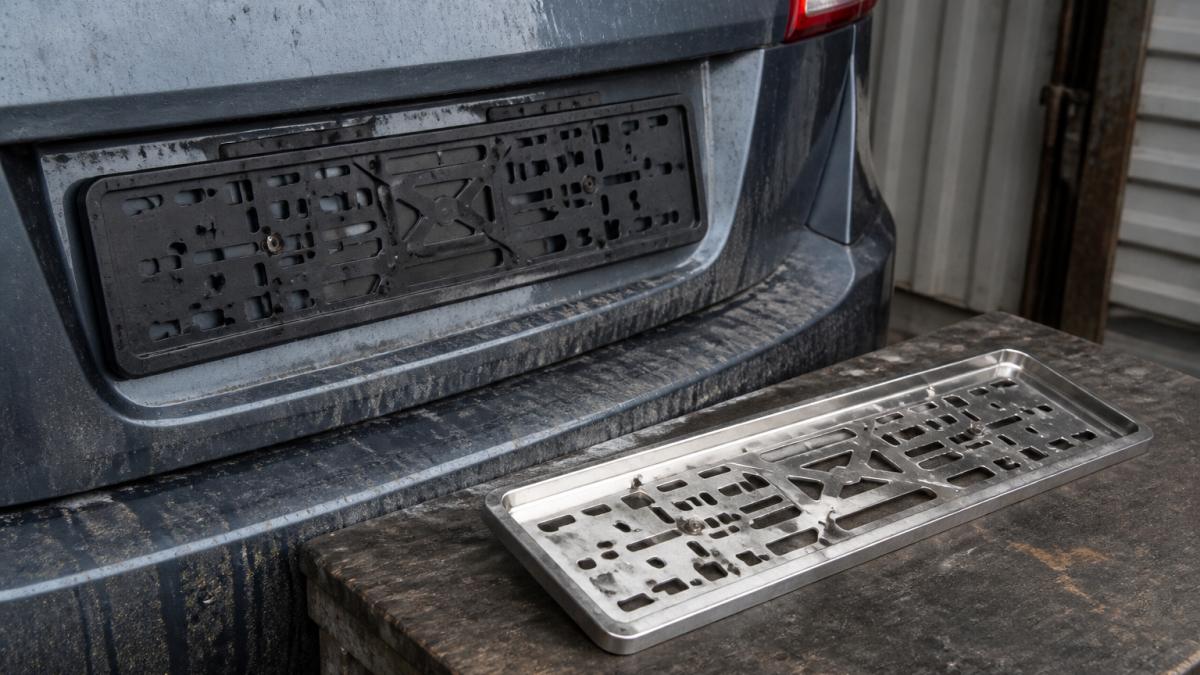
Universal number plate holder fit depends on two measurements: the plate itself and the recess on your car. Standard UK plates measure 520 mm by 111 mm. The holders in our range are described as suitable for any car with a standard-size plate.
Check these before you order:
- Plate size: measure your current plate. Imports and personalised plates sometimes run non-standard.
- Recess shape: curved and round-edge bumpers need a flexible frame, not a rigid one.
- Fixing points: confirm your existing screw holes line up, or that the holder uses the plate's own fixings.
If you drive an imported vehicle with an unusual chassis, measure first and match the holder to the plate, not the badge.
Number Plate Holder Fitting: Screws, No-Drill Options and Legal Visibility
Fitting takes minutes when the holder is designed for it, but the difference between a holder that lasts and one that cracks in a winter is in the preparation. Our hinged surrounds are described as mounting in one to three minutes with no drilling, and each set includes fixings and a manual.
What you need
- The holder and its supplied fixings
- A screwdriver that matches the screw head, a cross-head that cams out chews the head and the frame
- A cloth and a little warm soapy water to clean the recess
Screw-mounted frames
Screw-mounted frames are the traditional route and give a firm, stable hold. Work through it in this order:
2x Black Hinged Car Number Plate Surround Holder FOR ANY CAR TRUCK VAN TRAILER →
- Clean the recess and the back of the plate so grit is not trapped behind the frame.
- Offer the frame up dry, before driving any screw, and check the plate sits centred with even gaps.
- Start the screws by hand. Over-tightening on a plastic frame cracks it at the fixing point, and that crack spreads with vibration, hand-tighten only, then a quarter turn at most.
- Fit washers or caps where supplied so the screw head does not bear directly on plastic.
- Press each corner; a plate that rocks will fret and rattle.
No-drill hinged holders
No-drill hinged holders suit anyone who swaps plates often, such as trailer or caravan owners, because the plate slides in and clips shut. Fit the surround to the existing fixings first, then slide the plate in and confirm the clip engages fully. If the clip feels loose, the frame is usually sitting proud of the recess rather than seated against it.
Removing a holder without damaging paint
Work a plastic trim tool or an old credit card behind the frame at a corner and ease it away rather than levering. If the frame is screwed on, support it with one hand while undoing the last screw so it does not drop against the paint. Warm any adhesive pads gently and peel them back slowly.
Legal visibility
Legal visibility matters as much as security. DVLA guidance on display of registration marks sets out that plates must be clearly visible and not obscured, and an MOT tester will fail a plate that is insecure or unreadable.
For a ready-made hinged option, you can browse hinged number plate surrounds built for standard plates on cars, vans and trailers.

Custom Printed Number Plate Surround: Personalising a Daily Driver
A custom printed number plate surround turns a plain frame into a branding or styling detail. UV digital printing with epoxy resin gel doming is the finish used on our customisable holders, which are weather, temperature and vibration resistant.
That matters on a commuter car, where a printed surround faces the same weather as the plate.
Common uses include:
- Private owners adding a name, club logo or subtle design
- Small fleets carrying a business logo for cheap, constant advertising
- Dealers and garages branding stock vehicles
If you want a carbon-fibre look rather than a print, a carbon fibre style surround gives that finish without a custom design.

Choose Your Holder and Fit It This Weekend
Picking the right frame comes down to your commute, not the catalogue. Use this to decide:
| Commute condition | Best holder type | Why |
|---|---|---|
| Coastal or gritted roads | Stainless steel or premium black | Rust and chip resistant |
| Frequent plate swaps | Hinged no-drill surround | Clips open in seconds |
| Tight or curved bumper | Flexible hinged frame | Suits curved and round edges |
| Business or fleet use | Custom printed surround | UV print and resin doming |
| Budget daily driver | Standard black hinged pair | Low cost, MOT approved |
Once fitted, maintenance is simple: rinse the frame when you wash the car, check the fixings every few months, and touch in any chip before it spreads. That routine separates a frame that lasts years from one that fails in a single winter.
If you are comparing finishes for a hard-wearing setup, a premium black surround pair is built for daily exposure.

Frequently Asked Questions
What is the most durable material for a number plate holder?
It depends on how much impact the holder takes. ABS plastic with a rubberised or painted finish resists chips and cracking and stays lightweight, which is why most hinged surrounds use it. Stainless steel lasts longest against rust but costs more and adds weight. Silicone frames flex instead of cracking, so they suit curved bumpers and cars that get knocked in car parks. For a daily commute, look for UV-stable plastic or coated metal with weather, temperature and vibration resistance stated by the seller.
Will a universal number plate holder fit my imported car?
Universal number plate holders are sized for standard plate dimensions, so the deciding factor is your plate, not your chassis. Measure the plate itself before ordering and check the holder's stated product dimensions against it. Hinged surrounds are more flexible than rigid frames and suit curved or round-edge bumpers, which helps on imported models with non-standard recesses. If your plate has been trimmed or drilled unusually, check with the seller before buying.
How do I stop a number plate holder rattling on the motorway?
Rattles usually come from loose fixings or a frame that is not sitting flush. Refit the holder so it presses evenly against the bumper, use the washers supplied to spread the load, and check the screws are tight without over-torquing plastic. A rubber-coated or silicone-backed frame dampens vibration better than a hard plastic one. If the plate itself is loose inside the frame, a hinged holder with a clip-in plate keeps it firm and stable at speed.
Can I use a custom printed number plate surround on a daily driver?
Yes, provided the printing is built for outdoor use. UV digital printing with an epoxy resin gel dome protects the design from sunlight, temperature swings and road vibration, which is what causes cheap printed frames to fade and peel. Keep the printed area to the frame border so the plate characters stay fully visible and compliant. A custom printed number plate surround is a practical choice for commuters who want personalisation without swapping the holder every year.
Your commute will test whatever you fit, so choose a holder that is weather, temperature and vibration resistant rather than one that only looks the part on day one. TAPORT has been supplying custom and standard number plate holders since 2012, with UV digital printing and epoxy resin gel doming, fixings and a manual in every set, and fast delivery. Get started with TAPORT and fit a holder this weekend that will still look right next winter.
