

Last Updated: November 8, 2026
Quick Summary
Choose durable car accessories by checking fit and dimensions first, then inspecting wall thickness, seams, fixings and sealed finishes before you buy. Corrosion-resistant fixings, sealed or domed printing and a part that springs back without creaking all point to longer life. Divide price by expected lifespan to compare true annual cost.
- Standard UK and European number plates measure 520 mm by 111 mm, so measure the plate or panel before ordering.
- Welded and mechanically interlocked seams survive vibration better than glued butt joints.
- A part lasting three years costs a third of its price per year; a one-year part costs all of it.
- Sort reviews by newest first and read three-star ones for honest weaknesses.
- Rinse salt and grit off fixings in winter and re-tighten fixings each season.
Table of Contents
- Why Durable Car Accessories Cost Less Over Time
- Your Car Accessory Buying Guide: Start With Fit and Vehicle Compatibility
- Judging Material Quality and Sturdy Construction
- Weather-Resistant Car Accessories for British Conditions
- Durable Car Interior Accessories: What Survives Daily Use
- A Repeatable Durability Evaluation Checklist
- Reading Product Reviews and Owner Feedback Properly
- Safety, Legal and Vehicle-Warranty Considerations
- Car Accessory Maintenance Tips to Extend Product Life
- Choosing Number Plate Holders Built to Last
- Frequently Asked Questions
Why Durable Car Accessories Cost Less Over Time
A hinged number plate holder that survives several winters can cost less over time than a cheaper frame replaced every spring. That is the whole argument for buying durable car accessories, and it is the lens TAPORT uses when we assess anything that bolts onto a vehicle.
The maths is simple once you see it. A part that lasts three years costs a third of its price per year; a part that lasts one year costs all of it. Durability is a running cost, not a one-off price.
Your Car Accessory Buying Guide: Start With Fit and Vehicle Compatibility
Fit is the first filter in any car accessory buying guide, because a poorly fitting part works loose, rattles and wears out faster than a good one ever would. Check the size, the mounting points and the shape of the panel before anything else. A holder, cover or hook that fits properly puts less stress on its own fixings.
Measuring Before You Order
Measure the plate or panel, not the old accessory. Standard UK and European number plates measure 520 mm by 111 mm, and holders listed for that size are designed to suit standard plates. Write the numbers down and compare them to the listing before checkout.
Universal vs Vehicle-Specific Accessories
Universal parts fit a broad range of vehicles; vehicle-specific parts are shaped for one model. Universal wins on price and availability, and it is the right call for plate holders, hooks and sunshades. Vehicle-specific matters for anything that follows a curved panel or clips into a trim gap. If you drive an imported or non-standard model, check the plate dimensions rather than the badge. A plain black holder designed for any car, truck or van, like the Pure Black Car Number Plate Surround Holder, removes the guesswork entirely.

Judging Material Quality and Sturdy Construction
Sturdy construction is not a feeling you get in the shop, it is a set of inspectable details. The strongest buying guides stop at "looks solid"; the useful ones tell you what to look at, in what order, and what a failure looks like. Use the same inspection sequence on every accessory so you can compare products on equal terms rather than on first impressions.
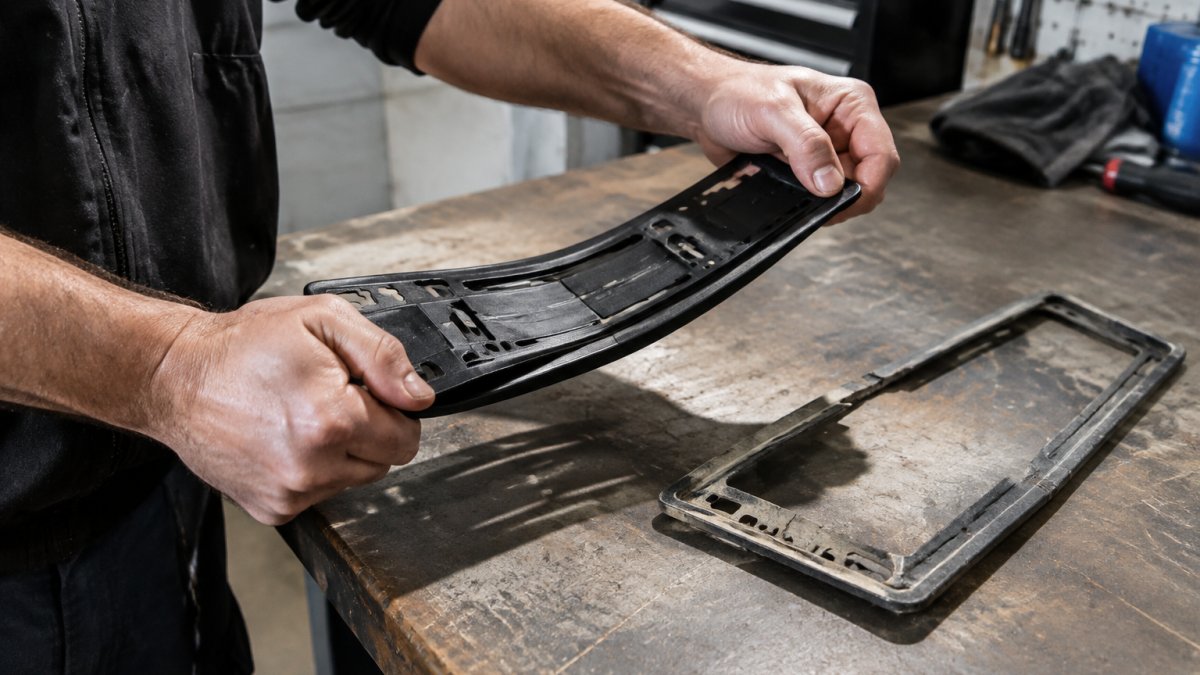
Inspect construction in this order
- Wall thickness and moulding quality. Run a thumbnail along an edge. Thin, sharp or wavy moulding lines mean a cheap tool and a part that will crack at the corner. A good moulding is uniform, with rounded edges and no visible weld lines across a load-bearing area.
- Seams and joints. On any two-piece item, check whether the seam is welded, glued, clipped or merely butted together. Welded and mechanically interlocked seams survive vibration; glued butt joints are the first thing to fail on a rattling panel.
- Fasteners and fixings. Look at what is in the box, not what is pictured. Corrosion-resistant fixings generally hold up better than plated ones. Check the thread pitch and head type, a screw that needs a special driver you do not own is a fitting you will never re-tighten.
- Connectors and load paths. On anything that carries weight or clips into trim, trace where the force goes. A hook that transfers load into a thin plastic clip will fail at the clip, not the hook. Metal load-bearing parts inside a plastic housing are usually a better sign than an all-plastic moulding.
- Surface finish over printed or coated faces. A printed finish should be sealed under a protective layer rather than applied as a sticker that peels at the edge. A carbon-style holder such as the CARBON FIBER CAR TUNING LICENSE NUMBER PLATE HOLDER SURROUND FRAME ANY CAR is one example of a design in this style.
- Flex and recovery. Twist the part gently and let it spring back. A frame that flexes and returns is usually a better bet than one that creaks or stays deformed. Creaking is a sign of internal stress that becomes a crack.
Durability by accessory category and material
Durability is not one-size-fits-all. The material that suits a floor mat is wrong for an electronics mount, and the wear points differ by category.
- Mats and floor liners. Rubber and thermoplastic elastomer resist water and salt; carpet mats wear at the heel pad first. Check the backing and the edge binding, because that is where they delaminate.
- Seat covers and upholstery protection. Look for reinforced seams at the bolster and a backing that does not shed. Wear shows first at the driver's entry edge.
- Organisers and storage. The failure point is almost always the clip or the hinge, not the fabric. Metal frames and thick mouldings outlast thin clips.
- Electronics and mounts. Heat is the enemy behind glass. UV-stable housings and sealed connectors matter more than a glossy screen. Check the cable strain relief, which is where most mounts fail.
- Exterior accessories such as plate holders and trims. Corrosion-resistant fixings and sealed finishes decide lifespan. A stainless-steel-effect holder, such as the Stainless Steel Effect Front Car Number Plate Surround Holder, gives you the corrosion-resistant look without the weight or cost of real steel.
Watch out: a print without a protective layer can fade over time. Plated screws can also corrode once the plating wears, so check fixings regularly.

Evidence-based longevity claims
Treat durability claims as claims to be tested, not facts. A warranty is only as good as its terms: check what is excluded, how long it runs, and whether it covers the failure you are most likely to see. Material specifications are more useful than marketing words, "UV-stabilised ABS" tells you more than "premium quality". Independent testing and long-term owner reviews are the best evidence available to a buyer, and a pattern of dated reviews mentioning the same failure is worth more than any single five-star rating.
Weather-Resistant Car Accessories for British Conditions
Weather resistance means handling rain, road salt, UV and temperature changes. Look for sealed surfaces and finishes that describe their weather resistance, and check that any printed face has a protective layer over it.
Watch out: a glossy print with no doming or lacquer will chalk and fade within a couple of summers, and there is no repair for it. A stainless-steel-effect holder, such as the Stainless Steel Effect Front Car Number Plate Surround Holder, gives you the corrosion-resistant look without the weight or cost of real steel. Washing salt off promptly in winter helps protect fixings from corrosion.
Durable Car Interior Accessories: What Survives Daily Use
Durable car interior accessories are the ones that cope with heat, sunlight and constant handling, not just the ones that look good on day one. Interior plastics can be exposed to strong heat and sunlight behind glass. But the more useful question is where each category actually fails, because that is what you should inspect before you buy.
Where interior accessories fail first
- Hooks and hangers. The clip or the hinge fails before the hook body. Check the load rating and whether the load path runs through metal or through a thin plastic tab.
- Organisers and boot tidies. Seams and base panels split under repeated loading. Reinforced stitching and a rigid base outlast soft-sided designs.
- Sunshades and blinds. The suction cup or the spring roller is the wear point, not the fabric.
- Phone mounts and charging cradles. Cable strain relief and the ball joint fail first. A mount with a replaceable arm lasts longer than a sealed one.
- Seat-back and console covers. Abrasion at the entry edge and elastic that loses tension are the usual failure modes.
Check the load rating before you hang anything heavy. A hook rated for a handbag is not rated for a toolbox. Avoid anything that clips onto an airbag cover or a trim panel that houses a sensor. In practice, the simplest designs last longest, because there is less to break.
Total cost of ownership and replacement value
The cheapest interior accessory is rarely the cheapest to own. Work out the annual cost rather than the shelf price: divide the purchase price by the expected lifespan in years, then add the cost of replacements and any fixings you have to buy separately. A part that lasts three years costs a third of its price per year; a part that lasts one year costs all of it. Repairability matters too, a mount with a replaceable arm or a shade with replaceable suckers can be kept going for years, while a sealed unit goes in the bin at the first failure.
Care and maintenance that extends life
Small habits repeated often do most of the work. Wipe printed and coated surfaces with plain water, never solvents. Re-tighten fixings at the start of each season, because loose fixings can vibrate and wear faster. Store spare parts flat and out of direct sunlight. Ten minutes a season is the difference between a part that lasts and one that fails in traffic.
Watch out: hanging a heavy bag on a hook rated for a lighter load can overload it, so check the rating before use.
A Repeatable Durability Evaluation Checklist
Run every accessory through the same short checklist before you buy, and you will stop guessing. It takes two minutes per item and saves returns, rattles and replacements.
- Dimensions match your plate or panel, measured not estimated
- Fixings included, and corrosion-resistant rather than plated
- Finish sealed, domed or lacquered over any printed surface
- Edges smooth, no sharp moulding lines or thin walls
- Flex test passed: the part springs back without creaking
- Load rating stated if the item carries weight
- Fitting time realistic, and no drilling required
- Reviews mention longevity, not just looks
Apply it to a pair like the 2 X Super Chrome Effect Number Plate Holder Surround and you will know within a minute whether the chrome is sealed and the fixings are worth fitting.
Run every accessory through the same short checklist before you buy, and you will stop guessing.
| Check | What to look for |
|---|---|
| Dimensions | Match your plate or panel, measured not estimated |
| Fixings | Included, and corrosion-resistant rather than plated |
| Finish | Sealed, domed or lacquered over any printed surface |
| Edges | Smooth, no sharp moulding lines or thin walls |
| Flex test | The part springs back without creaking |
| Load rating | Stated if the item carries weight |
| Fitting time | Realistic, and no drilling required |
| Reviews | Mention longevity, not just looks |
Reading Product Reviews and Owner Feedback Properly
Owner feedback is most useful when it is specific and dated. Sort reviews by newest first and read the three-star ones, which tend to describe real weaknesses honestly. Look for phrases about how long something lasted, not how shiny it arrived.
Ignore reviews that only mention delivery speed. A fast parcel tells you nothing about wear and tear. Search the page for the words "faded", "cracked", "rust" and "loose" and see how often they appear. One mention is noise; a pattern is a warning.
Safety, Legal and Vehicle-Warranty Considerations
Safety and legality come before appearance every time. Number plates must stay legible, correctly spaced and securely fixed, and a holder must not obscure the characters or the border. Choose MOT-approved fittings and check that the plate sits flat and square once mounted.
Modifications can affect a warranty if they cause the fault being claimed, so keep receipts and fit parts that need no drilling. A clamped or hinged holder avoids new holes in the bumper, which keeps the bodywork untouched. If you are unsure whether a part is compliant, ask the supplier before fitting rather than after.
Car Accessory Maintenance Tips to Extend Product Life
Car accessory maintenance tips are mostly about small habits repeated often. Rinse salt and grit off fixings in winter, dry the frame after a wash, and check screws every few months. Loose fixings vibrate, and vibration is what cracks plastic.
- Wipe printed surfaces with plain water, never solvents
- Re-tighten fixings at the start of each season
- Treat rubber seals with a silicone-safe conditioner
- Store spare plates and covers flat, out of sunlight
- Replace rusty screws before they seize
Ten minutes a season is the difference between a part that lasts and one that fails in traffic.
Choosing Number Plate Holders Built to Last
A durable holder comes down to four things: standard sizing, sealed printing, corrosion-resistant fixings and a fit that needs no drilling. Hinged designs make plate swaps quick for caravans, trailers and trade sellers, and a domed print holds its colour through weather, temperature and vibration.
That is how we build them at TAPORT. For a straightforward option, the 2x Black Hinged Car Number Plate Surround Holder FOR ANY CAR TRUCK VAN TRAILER is designed to suit any car, truck, van or trailer at £7.99.

The challenge is not finding accessories; it is finding ones that are still on the car in three years. TAPORT has been supplying personalised, weather-resistant number plate holders since 2012, with UV digital printing, epoxy resin gel doming and fast delivery on every order. Get started with TAPORT and fit accessories you won't need to replace next season.
Frequently Asked Questions
How can you tell if a car accessory is good quality before it arrives?
Look at three things: the stated material, the construction method and the seller's track record. A listing that names the material and describes how it resists weather, temperature and vibration is more trustworthy than one with vague claims. Check whether fixings and instructions are included, since that signals a complete product rather than a bare part. Finally, read owner feedback for comments on fit and longevity rather than just appearance, and check how long the seller has been trading.
What materials make durable car accessories?
Materials that hold their shape and resist moisture tend to last longest. For exterior trim, flexible plastics that cope with curved and round edges survive knocks better than rigid brittle types. For interior items, tightly woven fabrics and sealed surfaces resist spills and sunlight. Number plate holders finished with UV digital printing and epoxy resin gel doming are built to resist weather, temperature and vibration, which is exactly the wear pattern a plate frame sees on a daily commute.
Are universal car accessories as durable as vehicle-specific ones?
They can be, provided the universal part is designed around the standard dimensions it needs to fit. A number plate holder made for the standard plate size of 520 mm by 111 mm will fit any car with a standard plate, so there is no durability penalty for the universal design. Problems arise when a universal accessory relies on adapters or brackets that work loose. Where a part mounts with fixings straight to the vehicle, universal designs are often the more practical choice.
What should you check before buying car accessories online?
Confirm the dimensions against your own vehicle and check that fixings and a manual are included. Look at whether the seller states how the product handles weather and vibration.
How do you maintain car accessories so they last longer?
Wash exterior accessories with plain water and a mild soap rather than harsh solvents, and rinse off road salt promptly in winter. Check fixings every few months and tighten anything that has worked loose, since vibration is what shortens the life of most trim. For interior accessories, wipe spills quickly and keep them out of prolonged direct sun. A five-minute check at each service is usually enough to catch wear before it becomes a replacement.
Are personalised number plate holders weather-resistant?
They can be, depending on how the design is applied. Holders finished with UV digital printing and epoxy resin gel doming are designed to resist weather, temperature and vibration.
